Expozimetr light meter
A pocket light meter for film photography. It measures the light falling on the scene and, based on the aperture, shutter speed and film speed, calculates the correct exposure for a specific camera.
- Client
- Personal hardware for photographers
- Year
- 2024
- Status
- In development
- My role
- Hardware, Firmware, PCB design
- Technology
- ESP32-C3, C++, VEML7700, KiCad
About the project
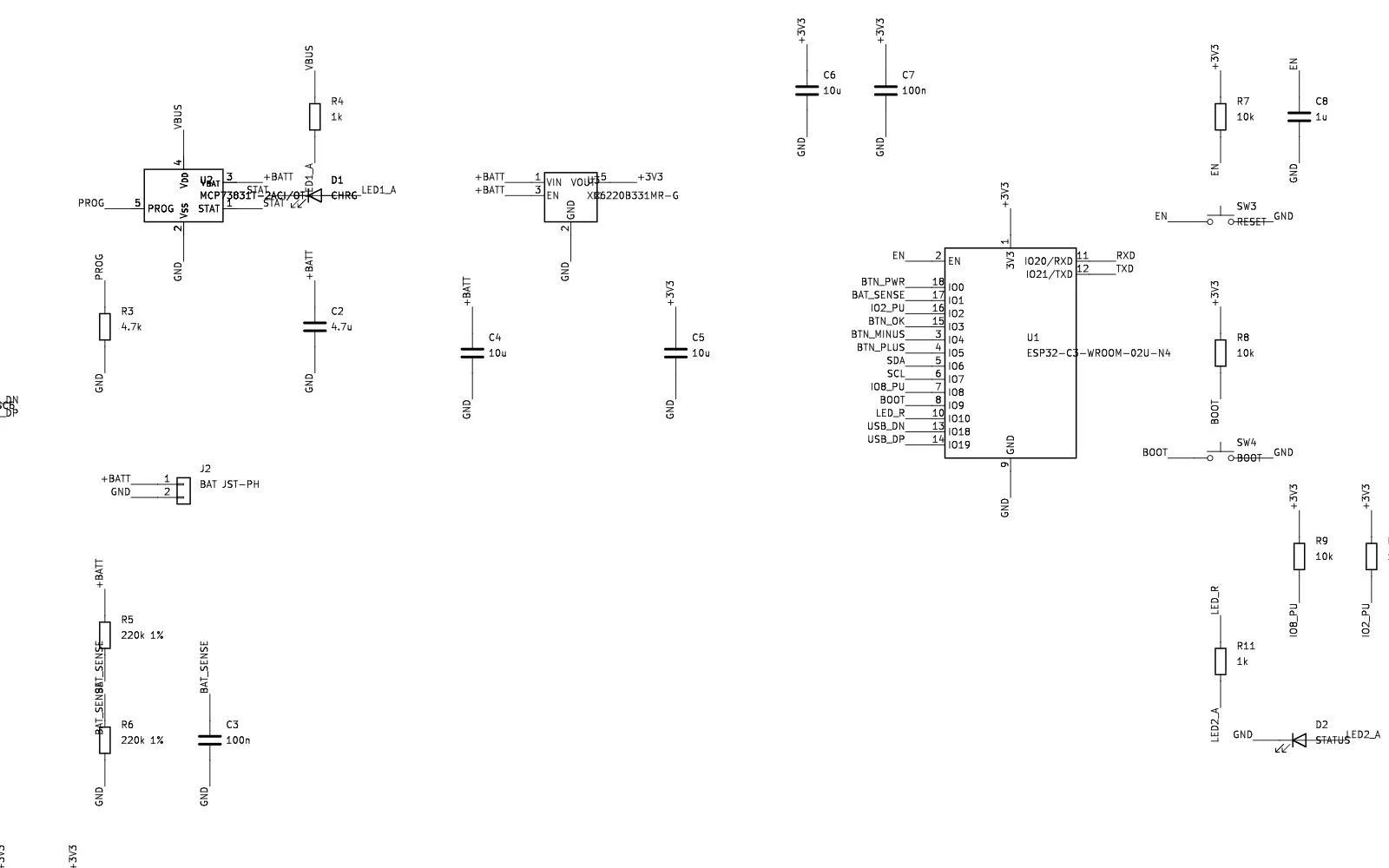
Old film cameras often lack a working light meter, so I built my own. It fits in the palm of your hand: an ESP32-C3, a sensitive VEML7700 light sensor, a small OLED display, a rotary encoder and a LiPo battery.
What it does
- Three modes: aperture priority, shutter priority and auto, which finds a balanced aperture and shutter speed pair within the lens’s range.
- Camera profile. The extreme apertures and shutter speeds are set for the specific camera (the default is a Rollei 35 SE), so the meter never suggests anything the camera cannot do.
- Real values. Results are rounded to the steps marked on the camera, in full, half or third stops. The remainder is shown in EV, for example
1/125 +0.3. - Exposure compensation, calibration against a reference meter, out-of-range warnings and a battery indicator.
- The sensor switches its sensitivity on its own without freezing the display. After five minutes of inactivity the device goes to sleep and wakes up at a touch of the encoder, without a restart.
How it is built
The exposure calculations, the menu and the conversion of sensor values live in separate libraries with no hardware dependencies, so they are verified by more than a hundred automated tests and CI checks every change. Firmware updates over USB accept only a signed image.
Status
The firmware is finished and runs on a development board. I am now designing a custom PCB in KiCad and a dome-shaped diffuser, so the meter also picks up light from the sides. Looking ahead, I plan secure boot and flash encryption so the light meter can be sold as a finished product.